

Window Menu
Ce contenu n’est pas encore disponible dans votre langue.
Native application menus can be attached to both to a window or system tray. Available on desktop.
Creating a base-level menu
Section titled “Creating a base-level menu”To create a base-level native window menu, and attach to a window. You can create various types of menu items including basic items, check items, and separators:
Use the Menu.new static function to create a window menu:
import { Menu } from '@tauri-apps/api/menu';
await using menu = await Menu.new({  items: [    {      id: 'quit',      text: 'Quit',      action: () => {        console.log('quit pressed');      },    },    {      id: 'check_item',      text: 'Check Item',      checked: true,    },    {      item: 'Separator',    },    {      id: 'disabled_item',      text: 'Disabled Item',      enabled: false,    },    {      id: 'status',      text: 'Status: Processing...',    },  ],});
// If a window was not created with an explicit menu or had one set explicitly,// this menu will be assigned to it.//// NOTE: will be empty macOS. On macOS, all top-level entries must be SubMenus.await menu.setAsAppMenu();
// Update individual menu item textawait using statusItem = await menu.get('status');if (statusItem) {  await statusItem.setText('Status: Ready');}
use tauri::menu::MenuBuilder;
fn main() { tauri::Builder::default() .setup(|app| { // NOTE: will be empty on macOS. On macOS, all top-level entries must be Submenus. let menu = MenuBuilder::new(app) .text("open", "Open") .text("close", "Close") .check("check_item", "Check Item") .separator() .text("disabled_item", "Disabled Item") .text("status", "Status: Processing...") .build()?;
app.set_menu(menu.clone())?;
// Update individual menu item text menu .get("status") .unwrap() .as_menuitem_unchecked() .set_text("Status: Ready")?;
Ok(()) }) .run(tauri::generate_context!()) .expect("error while running tauri application");}Listening to events on custom menu items
Section titled “Listening to events on custom menu items”Each custom menu item triggers an event when clicked. Use the on_menu_event API to handle them.
import { Menu } from '@tauri-apps/api/menu';
await using menu = await Menu.new({  items: [    {      id: 'Open',      text: 'open',      action: () => {        console.log('open pressed');      },    },    {      id: 'Close',      text: 'close',      action: () => {        console.log('close pressed');      },    },  ],});
await menu.setAsAppMenu();
use tauri::menu::MenuBuilder;
fn main() { tauri::Builder::default() .setup(|app| { let menu = MenuBuilder::new(app) .text("open", "Open") .text("close", "Close") .build()?;
app.set_menu(menu)?;
app.on_menu_event(move |app_handle: &tauri::AppHandle, event| {
println!("menu event: {:?}", event.id());
match event.id().0.as_str() { "open" => { println!("open event"); } "close" => { println!("close event"); } _ => { println!("unexpected menu event"); } } });
Ok(()) }) .run(tauri::generate_context!()) .expect("error while running tauri application");}Creating a multi-level menu
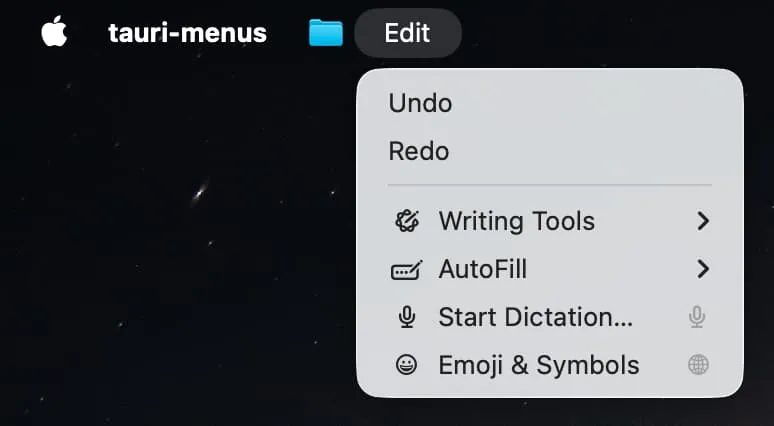
Section titled “Creating a multi-level menu”Multi-level menus allow you to group menu items under categories like “File,” “Edit,” etc. These will appear as part of the application window for Windows or Linux, or in the menu bar on MacOS.
import { Menu, Submenu } from '@tauri-apps/api/menu';
// Will become the application submenu on MacOSawait using aboutSubmenu = await Submenu.new({  text: 'About',  items: [    {      id: 'quit',      text: 'Quit',      action: () => {        console.log('Quit pressed');      },    },  ],});
await using fileSubmenu = await Submenu.new({  text: 'File',  icon: 'Folder', // Optional: Add an icon to the submenu  items: [    {      id: 'new',      text: 'New',      action: () => {        console.log('New clicked');      },    },    {      id: 'open',      text: 'Open',      action: () => {        console.log('Open clicked');      },    },    {      id: 'save_as',      text: 'Save As...',      action: () => {        console.log('Save As clicked');      },    },  ],});
// Note: macOS injects additional "Writing Tools" elements into "Edit" menus// (or, failing that, any menu with the "Copy" command).await using editSubmenu = await Submenu.new({  text: 'Edit',  items: [    {      id: 'undo',      text: 'Undo',      action: () => {        console.log('Undo clicked');      },    },    {      id: 'redo',      text: 'Redo',      action: () => {        console.log('Redo clicked');      },    },  ],});
await using menu = await Menu.new({  items: [aboutSubmenu, fileSubmenu, editSubmenu],});
await menu.setAsAppMenu();
// You can also update the submenu icon dynamicallyawait fileSubmenu.setIcon('document');// Or set a native icon (only one type applies per platform)await fileSubmenu.setNativeIcon('NSFolder');
use tauri::{ image::Image, menu::{CheckMenuItemBuilder, IconMenuItemBuilder, MenuBuilder, SubmenuBuilder},};
fn main() { tauri::Builder::default() .setup(|app| { // Will become the application submenu on macOS let about_menu = SubmenuBuilder::new(app, "About") .text("quit", "Quit") .build()?;
let menu_image = Image::from_bytes(include_bytes!("../icons/menu.png")).unwrap(); let file_menu = SubmenuBuilder::new(app, "File") .submenu_icon(menu_image) // Optional: Add an icon to the submenu .text("open", "Open") .text("quit", "Quit") .build()?;
let lang_str = "en"; let check_sub_item_1 = CheckMenuItemBuilder::new("English") .id("en") .checked(lang_str == "en") .build(app)?;
let check_sub_item_2 = CheckMenuItemBuilder::new("Chinese") .id("zh") .checked(lang_str == "zh") .enabled(false) .build(app)?;
// Load icon from path let icon_image = Image::from_bytes(include_bytes!("../icons/icon.png")).unwrap();
let icon_item = IconMenuItemBuilder::new("icon") .icon(icon_image) .build(app)?;
let other_item = SubmenuBuilder::new(app, "language") .item(&check_sub_item_1) .item(&check_sub_item_2) .item(&icon_item) .build()?;
let menu = MenuBuilder::new(app) .items(&[&about_menu, &file_menu, &other_item]) .build()?;
app.set_menu(menu)?;
let menu_image_update = Image::from_bytes(include_bytes!("../icons/menu_update.png")).unwrap(); // You can also update the submenu icon dynamically file_menu.set_icon(Some(menu_image_update))?; // Or set a native icon (only one type applies per platform) file_menu.set_native_icon(Some(tauri::menu::NativeIcon::Folder))?;
Ok(()) }) .run(tauri::generate_context!());}Note that you need to enable image-ico or image-png feature to use this API:
[dependencies]tauri = { version = "...", features = ["...", "image-png"] }Creating predefined menu
Section titled “Creating predefined menu”To use built-in (native) menu items that has predefined behavior by the operating system or Tauri:
import { Menu, PredefinedMenuItem, Submenu } from '@tauri-apps/api/menu';
// macOS injects additional "Writing Tools" menu items into your "Edit" menu,// or, if that's missing, whichever menu has this copy item:await using copy = await PredefinedMenuItem.new({  text: 'copy-text',  item: 'Copy',});
await using separator = await PredefinedMenuItem.new({  text: 'separator-text',  item: 'Separator',});
await using undo = await PredefinedMenuItem.new({  text: 'undo-text',  item: 'Undo',});
await using redo = await PredefinedMenuItem.new({  text: 'redo-text',  item: 'Redo',});
await using cut = await PredefinedMenuItem.new({  text: 'cut-text',  item: 'Cut',});
await using paste = await PredefinedMenuItem.new({  text: 'paste-text',  item: 'Paste',});
await using select_all = await PredefinedMenuItem.new({  text: 'select_all-text',  item: 'SelectAll',});
// Becomes the application submenu on MacOSawait using about = await Submenu.new({ text: 'About', items: [] });
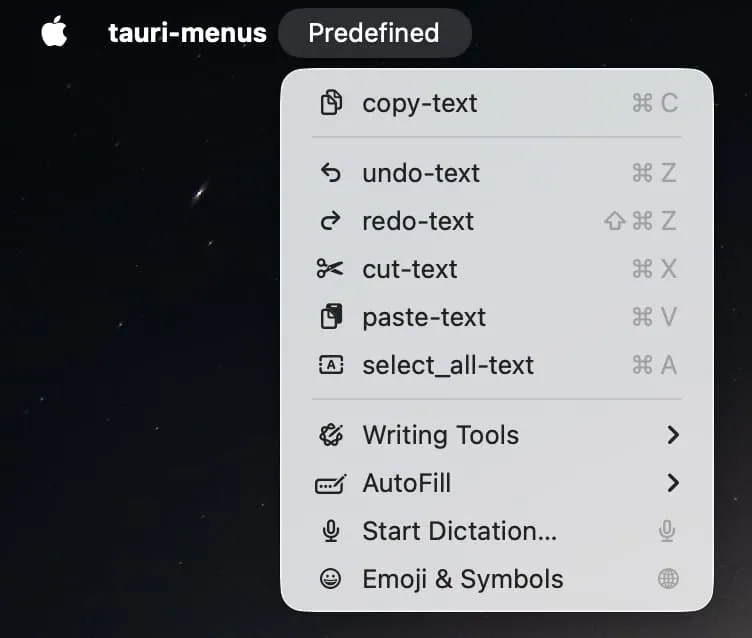
await using predefined = await Submenu.new({  text: 'Predefined',  items: [copy, separator, undo, redo, cut, paste, select_all],});
await using menu = await Menu.new({  items: [about, predefined],});
await menu.setAsAppMenu();
#![cfg_attr(not(debug_assertions), windows_subsystem = "windows")]use tauri::menu::{MenuBuilder, PredefinedMenuItem, SubmenuBuilder};
fn main() { tauri::Builder::default() .setup(|app| { // Becomes the application submenu on macOS let about_menu = SubmenuBuilder::new(app, "About").build()?;
let predefined_menu = SubmenuBuilder::new(app, "Predefined") .copy() .separator() .undo() .redo() .cut() .paste() .select_all() .item(&PredefinedMenuItem::copy(app, Some("custom text"))?) .build()?;
let menu = MenuBuilder::new(app) .items(&[&about_menu, &predefined_menu]) .build()?; app.set_menu(menu)?;
Ok(()) }) .run(tauri::generate_context!()) .expect("error while running tauri application");}For more preset capabilities, please refer to the documentation PredefinedMenuItem.
The result:
Change menu status
Section titled “Change menu status”If you want to change the status of the menu, such as text, icon, or check status, you can set_menu again:
import {  Menu,  CheckMenuItem,  IconMenuItem,  MenuItem,  Submenu,} from '@tauri-apps/api/menu';import { Image } from '@tauri-apps/api/image';
let currentLanguage = 'en';
// No `await using`: these items are used inside their `action` callbacks, so must not be freed at end of scope.//// You must `.close()` them manually later.const check_sub_item_en = await CheckMenuItem.new({  id: 'en',  text: 'English',  checked: currentLanguage === 'en',  action: () => {    currentLanguage = 'en';    check_sub_item_en.setChecked(currentLanguage === 'en');    check_sub_item_zh.setChecked(currentLanguage === 'zh');    console.log('English pressed');  },});
const check_sub_item_zh = await CheckMenuItem.new({  id: 'zh',  text: 'Chinese',  checked: currentLanguage === 'zh',  action: () => {    currentLanguage = 'zh';    check_sub_item_en.setChecked(currentLanguage === 'en');    check_sub_item_zh.setChecked(currentLanguage === 'zh');    check_sub_item_zh.setAccelerator('Ctrl+L');    console.log('Chinese pressed');  },});
// Load icon from pathawait using icon = await Image.fromPath('../src/icon.png');const icon2 = await Image.fromPath('../src/icon-2.png');
const icon_item = await IconMenuItem.new({  id: 'icon_item',  text: 'Icon Item',  icon: icon,  action: () => {    icon_item.setIcon(icon2);    console.log('icon pressed');  },});
const text_item = await MenuItem.new({  id: 'text_item',  text: 'Text Item',  action: () => {    text_item.setText('Text Item Changed');    console.log('text pressed');  },});
// Becomes the application submenu on MacOSawait using about = await Submenu.new({ text: 'About', items: [] });
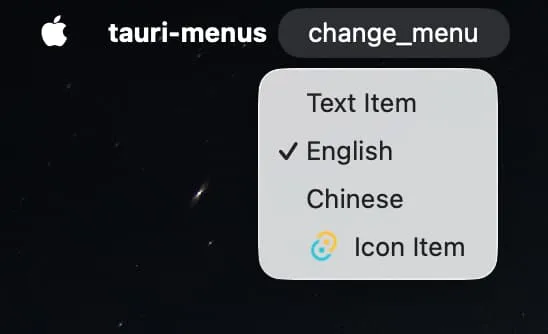
await using change_menu = await Submenu.new({  id: 'change_menu',  text: 'change_menu',  items: [text_item, check_sub_item_en, check_sub_item_zh, icon_item],});
await using menu = await Menu.new({  items: [about, change_menu],});
await menu.setAsAppMenu();
// change-menu-status#![cfg_attr(not(debug_assertions), windows_subsystem = "windows")]
use tauri::{ image::Image, menu::{CheckMenuItemBuilder, IconMenuItem, MenuBuilder, MenuItem, SubmenuBuilder},};
fn main() { tauri::Builder::default() .setup(|app| { let check_sub_item_en = CheckMenuItemBuilder::with_id("en", "EN") .checked(true) .build(app)?;
let check_sub_item_zh = CheckMenuItemBuilder::with_id("zh", "ZH") .checked(false) .build(app)?;
let text_menu = MenuItem::with_id( app, "change_text", &"Change menu".to_string(), true, Some("Ctrl+Z"), ) .unwrap();
let icon_menu = IconMenuItem::with_id( app, "change_icon", &"Change icon menu", true, Some(Image::from_bytes(include_bytes!("../icons/icon.png")).unwrap()), Some("Ctrl+F"), ) .unwrap();
// Becomes the application submenu on macOS let about_menu = SubmenuBuilder::new(app, "About").build()?;
let menu_item = SubmenuBuilder::new(app, "Change menu") .item(&text_menu) .item(&icon_menu) .items(&[&check_sub_item_en, &check_sub_item_zh]) .build()?; let menu = MenuBuilder::new(app).items(&[&about_menu, &menu_item]).build()?; app.set_menu(menu)?; app.on_menu_event(move |_app_handle: &tauri::AppHandle, event| { match event.id().0.as_str() { "change_text" => { text_menu .set_text("changed menu text") .expect("Change text error");
text_menu .set_text("changed menu text") .expect("Change text error"); } "change_icon" => { icon_menu .set_text("changed menu-icon text") .expect("Change text error"); icon_menu .set_icon(Some( Image::from_bytes(include_bytes!("../icons/icon-2.png")).unwrap(), )) .expect("Change icon error"); }
"en" | "zh" => { check_sub_item_en .set_checked(event.id().0.as_str() == "en") .expect("Change check error"); check_sub_item_zh .set_checked(event.id().0.as_str() == "zh") .expect("Change check error"); check_sub_item_zh.set_accelerator(Some("Ctrl+L")) .expect("Change accelerator error"); } _ => { println!("unexpected menu event"); } } });
Ok(()) }) .run(tauri::generate_context!()) .expect("error while running tauri application");}The menu looks like this:
Prevent JavaScript menu leaks
Section titled “Prevent JavaScript menu leaks”There’re a few gotchas you should be aware of when using the JavaScript menu APIs, mainly because JavaScript does not have any way to run cleanup code when an object is being removed by garbage collection:
- The menus will not clean up automatically unless
closeis called or closed byawait usingafter the binding variable goes out of scope. - You should close the menu items you got e.g. from
Menu.get, theawait usingsyntax makes it easier, for example:await using status = menu.get('status')Be careful with APIs that can return aMenusuch asMenu.setAsAppMenu, you’ll need to close them when you’re done with them or if you don’t plan to use them. - You should close the menu resource whenever you don’t need to access it in JavaScript anymore.
For example:
const copy = await PredefinedMenuItem.new({ item: 'Copy' });const menu = await Menu.new({ items: [copy] });// `copy` is now managed by the `menu` and the JavaScript resource reference can be closedawait copy.close();
const prev = await menu.setAsAppMenu();// `menu` is now set as the app menu, we can close the JavaScript resource referenceawait menu.close();// We don't plan to use the previously set menu, close it here.await prev?.close();
await using copy = await PredefinedMenuItem.new({ item: 'Copy' });await using menu = await Menu.new({ items: [copy] });await using prev = await menu.setAsAppMenu();© 2026 Tauri Contributors. CC-BY / MIT